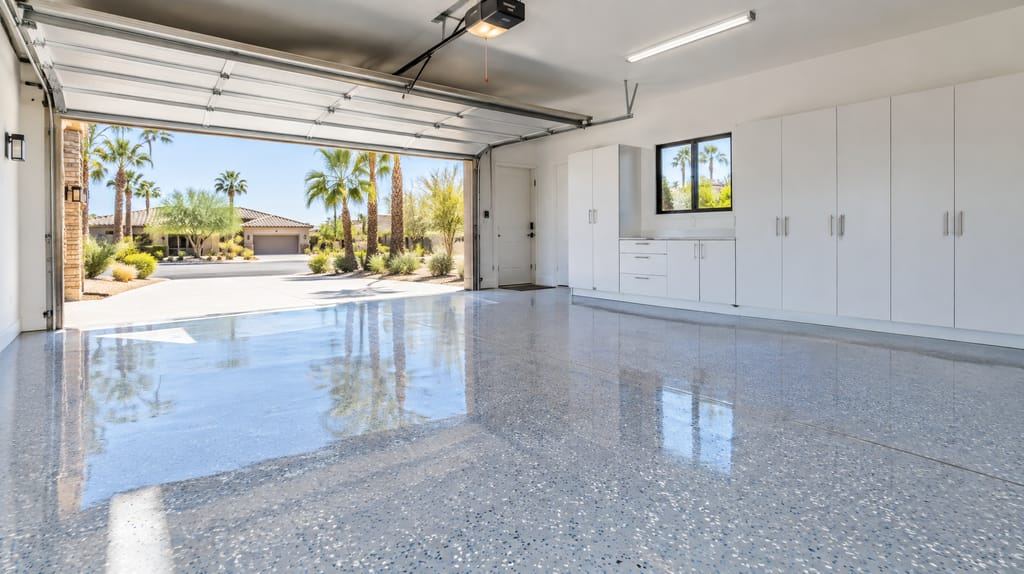
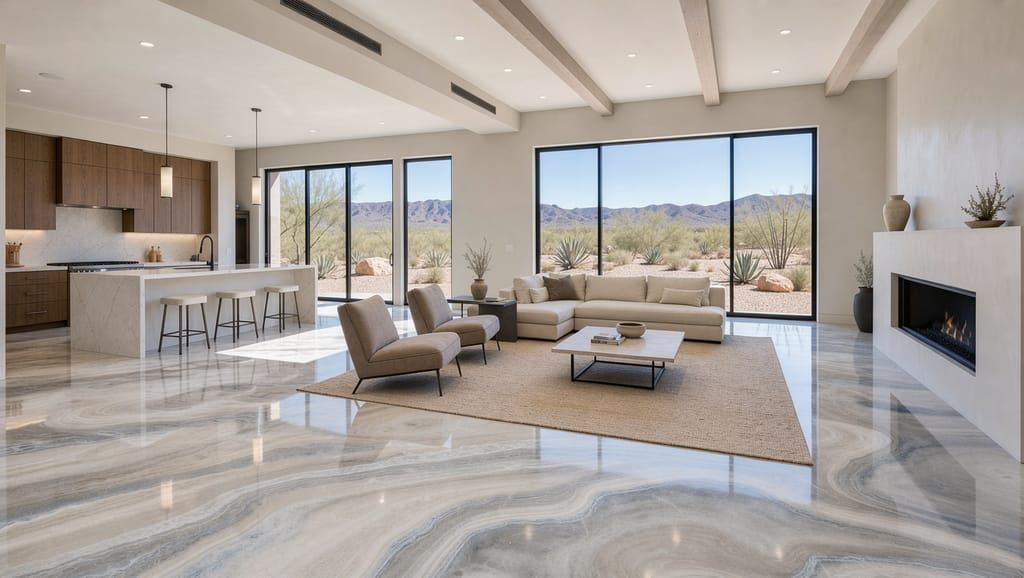
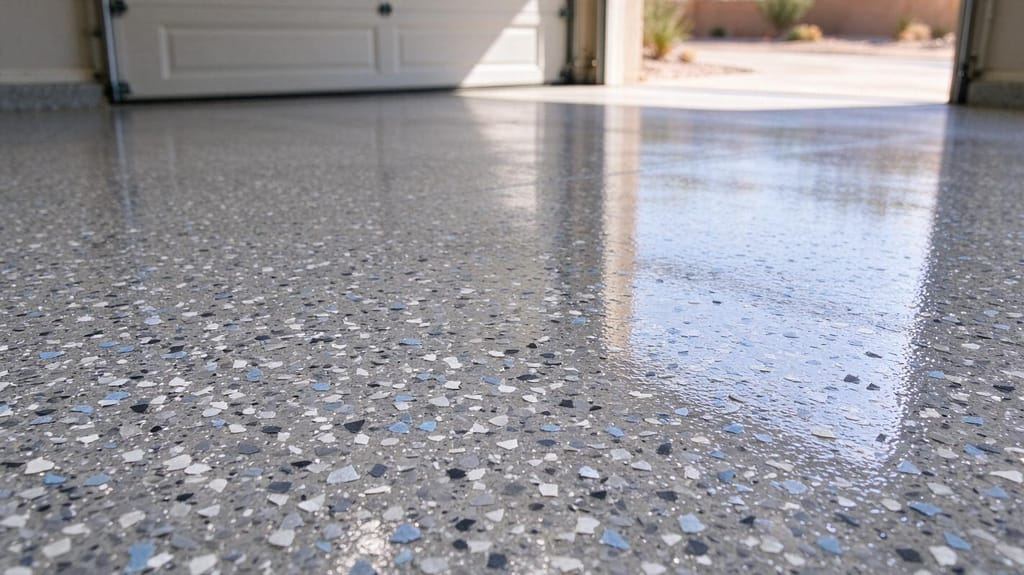
What is a polyaspartic floor coating?
Polyaspartic coatings are a class of aliphatic polyurea resins developed to offer the toughness of polyurea with a more workable cure speed. In practical terms, polyaspartic is a fast-curing, high-performance coating that bonds strongly, resists abrasion and chemicals, and, importantly for Arizona, does not yellow under UV light. It is one of the main reasons modern garage floor coatings can be installed in a single day.
Polyaspartic can be used as a complete floor system or, more commonly, as the clear topcoat over a pigmented base and decorative flake. It is also an excellent protective finish over metallic and solid-color epoxy floors, where its UV stability keeps colors bright and true.
Why polyaspartic works so well in Gilbert
UV stability
Traditional epoxy is aromatic, which means it can amber and chalk when exposed to sunlight. In a garage with the door open or a patio in full sun, that discoloration can appear within months. Polyaspartic is aliphatic, so it holds its color and gloss in direct sun. For Arizona homes, that alone makes it the preferred topcoat.
Heat and hot tire resistance
Arizona tires roll in hot and soft after sitting on summer pavement. Polyaspartic topcoats offer excellent resistance to hot tire pickup and to the softening effect of tire plasticizers. Combined with proper grinding and a well-bonded base coat, this keeps your floor intact through the hottest months.
Fast return to service
Polyaspartic cures in hours rather than days. That allows us to grind, repair, base coat, broadcast and topcoat in a single working day for most garages. You can typically walk on the floor that evening and drive on it within 24 to 48 hours, depending on temperature and humidity.
Abrasion and chemical resistance
Polyaspartic topcoats hold up well against foot traffic, rolling toolboxes, gym equipment and vehicle traffic. They resist gasoline, oil, antifreeze, brake fluid, many household chemicals and pool products, and they clean up easily.
Wide temperature window
Many coatings struggle in very hot or cold conditions. Polyaspartic formulations can be adjusted for the season, which helps us install reliably year-round in the Valley, including summer mornings when epoxy would set too fast to work properly.
Polyaspartic versus epoxy
Epoxy still has an important role. It has a long working time, high build and excellent adhesion, which make it ideal for metallic floors, self-leveling body coats and certain base coats. Polyaspartic, by contrast, shines as a fast, durable, UV-stable topcoat and as the backbone of one-day systems. The two are often used together: an epoxy or polyurea base for adhesion and build, and a polyaspartic topcoat for wear, UV and heat protection.
| Feature | Epoxy | Polyaspartic |
|---|---|---|
| UV stability | Can yellow in sunlight | Non-yellowing |
| Cure time | 12 to 24 hours between coats | 1 to 4 hours between coats |
| Return to vehicle traffic | About 72 hours | About 24 to 48 hours |
| Hot tire resistance | Good with topcoat | Very good |
| Best role | Base and body coats, metallics | Topcoats and one-day systems |
Our one-day polyaspartic garage system
Our one-day system is designed for busy Gilbert households that do not want to give up their garage for several days. Here is how a typical day unfolds.
Morning: grinding and repairs
We arrive, mask the garage and diamond grind the slab with dust-controlled equipment. Cracks, pits and spalls are repaired with fast-setting materials and ground flush.
Midday: base coat and broadcast
A pigmented, fast-curing base coat is applied, and decorative flake is broadcast to full coverage. The fast chemistry allows the base to cure in a short time even in warm weather.
Afternoon: scrape, vacuum and topcoat
Once the base is cured, excess flake is scraped and vacuumed, and the clear polyaspartic topcoat is rolled over the floor. Anti-slip additive can be included in this coat.
Evening: walkthrough
We remove masking, walk the floor with you and leave a care sheet with exact return-to-service times.
Does fast cure mean less durable?
This is a common question, and the answer is no, as long as the installer understands the material. Polyaspartic cures quickly because of its chemistry, not because it is thin or weak. The real risk with fast-curing products is poor installation: rushed prep, coatings applied too thinly or a crew that cannot work quickly enough to keep a wet edge. Our installers are trained on the materials we use and plan each floor so the coating goes down evenly and bonds properly.
What matters most for durability is the same as with any coating: thorough diamond grinding, proper crack repair, enough film thickness and a compatible system. Speed is a benefit, not a shortcut.
Where we use polyaspartic coatings
- Residential garages
- Covered patios and walkways
- Pool surrounds (with texture)
- Commercial showrooms
- Auto shops and service bays
- Restaurants and retail
- Topcoats over metallic floors
- Topcoats over flake floors
Caring for a polyaspartic floor
Polyaspartic floors are easy to maintain. Sweep or dust-mop regularly, then wash with warm water and a pH-neutral cleaner. For tire marks, a mild degreaser and soft brush usually do the job. Avoid strong acids and citrus solvents. Use mats under vehicles that drip, and pads under heavy equipment. Over many years, a commercial floor may benefit from a maintenance topcoat, which can be applied quickly with minimal downtime.
Polyaspartic and the Arizona install window
Temperature and humidity affect every resin, but Arizona summers push most products to their limits. Standard epoxies can set too quickly on a hot slab, leaving roller marks, poor flow and weak bonding. Polyaspartic formulations are available in different cure speeds, so we can choose a slower blend for hot days and a faster blend for cooler months. On summer projects we often start at first light, when the slab is coolest, and plan the work so each coat goes down within the material's ideal window.
Humidity matters too. During monsoon season, higher moisture in the air can speed up the reaction of some polyaspartics and affect their surface finish. Our installers monitor conditions with thermometers and hygrometers and adjust batch sizes and timing so the coating levels and cures properly. This attention to conditions is one of the main differences between a professional polyaspartic floor and one that looks blotchy or fails early.
Why topcoat choice matters
The topcoat is the part of the floor you actually walk and drive on. It takes the abrasion, the hot tires, the chemical spills and the sunlight. A thin or low-quality topcoat wears through quickly, exposing the flake or base beneath to damage. We apply polyaspartic topcoats at proper film thickness and can add a second topcoat for heavy-use garages and commercial spaces. Thicker topcoats also give a smoother finish that is easier to clean, while a single coat leaves more texture for grip. We help you choose the balance that suits how you use the floor.
Common questions about one-day floors
Homeowners sometimes worry that a floor finished in one day must be a shortcut. In reality, the timeline is possible because polyaspartic chemistry cures faster, not because steps are skipped. Every one-day floor we install still includes diamond grinding, crack repair, a full base coat, full flake broadcast and a clear topcoat. The difference is that each layer is ready for the next in hours rather than overnight. That means less disruption for your family and a garage that is back in use by the next day or two.
Why choose us for polyaspartic coatings
- Experienced crews trained on fast-cure polyaspartic systems
- Diamond grinding and repairs before every installation
- Seasonal formulations for reliable results in Arizona heat
- Clear, written return-to-service times
- Flake, solid color and clear-coat options
Want your garage back by tonight? Request a free estimate with the form above and ask about our one-day polyaspartic system. Visit our garage floor coatings page to compare options.