Why Gilbert homeowners coat their garage floors
In most Gilbert homes, the garage is the busiest entrance in the house. Cars, bikes, strollers, coolers, golf bags and groceries all come through it, and so does the dust that blows in every time the door goes up. Bare concrete absorbs oil and antifreeze, sheds a fine powder that settles on everything you store, and shows every tire mark and drip. A professionally installed garage floor coating changes all of that. It seals the slab, brightens the whole room, wipes clean in minutes and gives the space the same finished feel as the rest of your home.
A coated garage floor is also one of the most practical upgrades you can make before selling. Buyers walking through a Val Vista Lakes, Power Ranch or Morrison Ranch listing notice a clean, glossy garage immediately, and it signals that the home has been cared for. For families who plan to stay, the payoff is daily: less sweeping, no more stains, and a room that can double as a gym, workshop, hobby space or play area without feeling like an afterthought.
What makes Arizona garages different
Garage floors in the East Valley face conditions that coatings in milder climates never see. A west-facing garage in late afternoon can push slab surface temperatures well past 120 degrees, then cool sharply overnight. That daily swing makes concrete expand and contract, which stresses any rigid coating that is not well bonded. Tires that have been sitting on hot asphalt arrive soft and hot, and the plasticizers in them can soften and lift weak or thin coatings. This is what installers call hot tire pickup, and it is the most common reason cheap garage coatings fail in Arizona.
Sunlight is the other challenge. Many Gilbert families leave the garage door open while they work in the driveway or the kids play outside, and direct UV exposure causes standard epoxy to amber and chalk over time. Monsoon season adds blowing dust, sudden water and mud. Hard water leaves mineral spots, and pool chemicals, fertilizers and lawn products often get stored right on the garage floor. Our garage systems are built around all of these conditions, not around a generic product sheet.
Our garage floor coating systems
We offer several garage systems so you can choose the look, durability and budget that suit your home. During your estimate we will explain which one we recommend for your slab and why.
Full-broadcast flake system
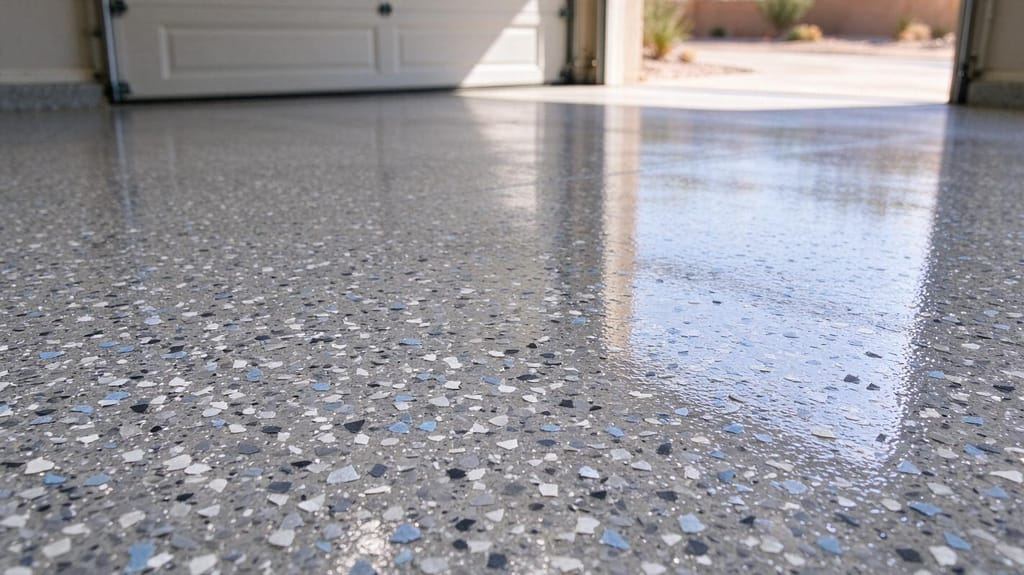
This is our most popular garage floor and the one we recommend for most Gilbert homes. A pigmented base coat is applied to the ground slab, and decorative vinyl flake is broadcast into it until the surface is completely covered. Once cured, the loose flake is scraped and vacuumed away and a clear, UV-stable polyaspartic topcoat seals everything in. The result is a textured, terrazzo-like surface that hides dust and tire marks, offers natural slip resistance and stays bright under direct sun. Learn more on our decorative flake flooring page.
One-day polyaspartic system
When you need your garage back quickly, a polyaspartic-based system lets us grind, repair, coat and topcoat in a single working day. You can usually walk on the floor that evening and return vehicles after about 24 to 48 hours, depending on temperature and humidity. Polyaspartic chemistry is UV stable, highly abrasion resistant and handles hot tires well, which makes it a strong match for Arizona garages. See our polyaspartic floor coatings page for details.
Solid-color epoxy with topcoat
Some homeowners prefer a clean, uniform color for a showroom or workshop feel. We install a high-solids epoxy body coat in your chosen color, add optional anti-slip aggregate, and finish with a UV-stable topcoat so the color does not yellow. Solid colors look sharp but show dust and tire marks more readily than flake, so we will talk through how you use the space before you decide.
Metallic garage floors
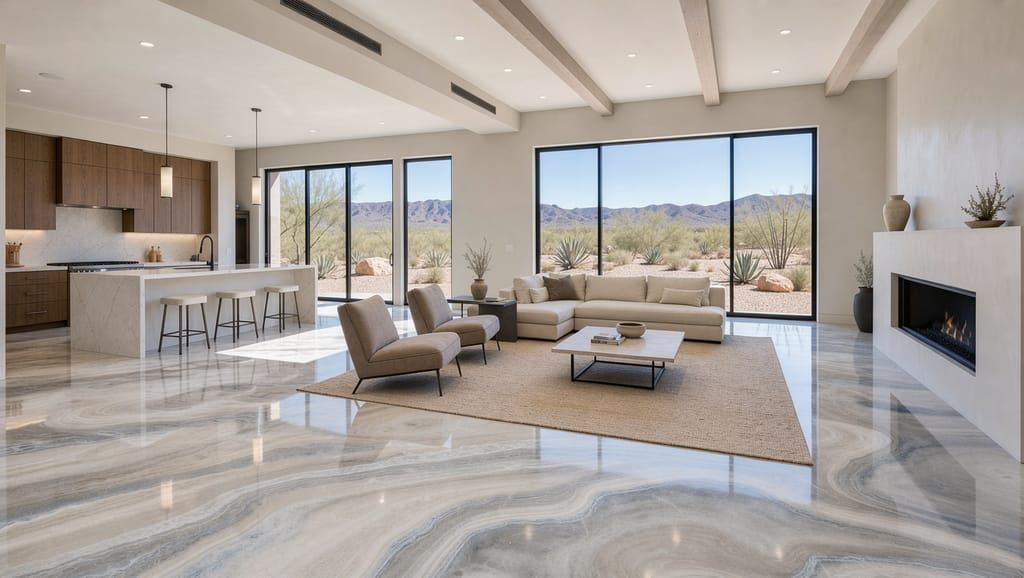
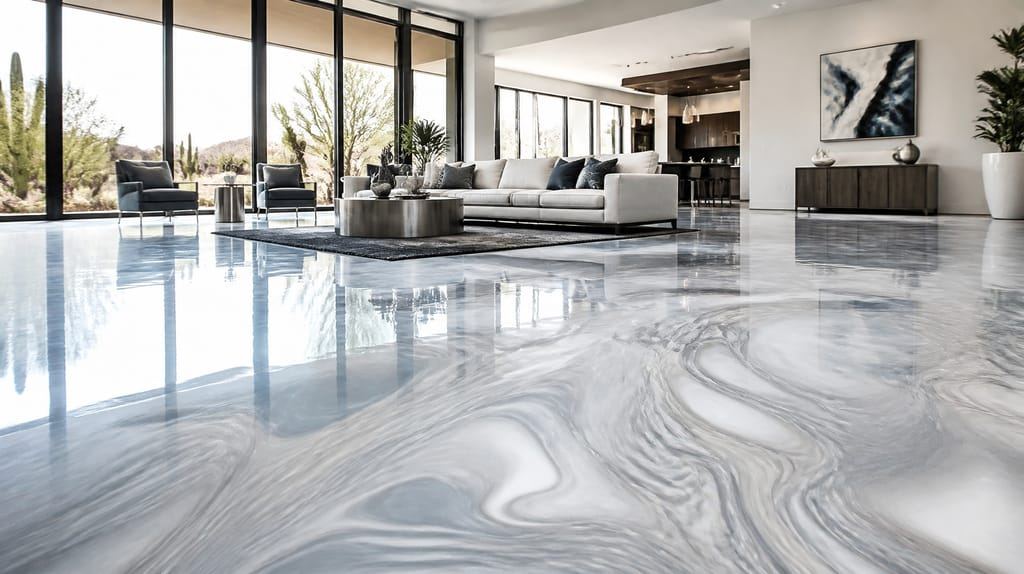
For car collectors and anyone who wants a true statement floor, a metallic epoxy system creates depth and movement that looks like polished stone or flowing liquid. It takes more skill and labor than other systems and is best suited to garages that function as display spaces. Visit our metallic epoxy flooring page to see how it works.
Our garage floor installation process
A garage floor coating is only as strong as its bond to the concrete, so most of the skill in a lasting floor happens before any color goes down. Here is what a typical install day looks like.
1. Protect and prepare the space
We ask that the garage be cleared before we arrive. Our crew masks walls, cabinets, water heaters and doors with plastic and tape, and protects the driveway where equipment will sit.
2. Diamond grind the slab
Using planetary diamond grinders connected to industrial vacuums, we remove the weak surface layer of the concrete, along with old sealers, paint, adhesives and contamination. Grinding creates a uniform profile that lets the base coat soak into sound concrete. Edges and corners are handled with smaller hand grinders so the bond is just as strong at the walls as in the middle of the floor.
3. Repair cracks, pits and joints
Cracks are chased and filled, spalled areas and pits are patched, and control joints are either filled or honored depending on the slab. Many Gilbert garages built in the 1990s and 2000s have years of hairline cracking, and repairing it properly now prevents those lines from telegraphing through the finished floor.
4. Moisture check and base coat
We confirm the slab is ready, then apply the base coat. If moisture readings call for it, we use a moisture-tolerant primer first. The base coat is pigmented to complement your flake blend so the floor looks rich and consistent.
5. Flake broadcast and topcoat
Flake is broadcast to full coverage, then scraped and vacuumed once it cures. A clear polyaspartic topcoat is rolled over the entire floor, locking in the flake and providing the wear surface you will live on. We can add a fine anti-slip additive for extra traction.
6. Walkthrough and care instructions
Before we leave, we walk the floor with you, remove masking and give you a simple care sheet with return-to-service times for foot traffic and vehicles.
Choosing colors and flake blends
Flake blends range from subtle grays and tans that complement desert stucco to bold mixes with blue, black and white accents. The size of the chip changes the look as well: larger chips feel bold and graphic, while smaller chips read as a finer, more uniform texture. Our team brings physical samples to your estimate so you can see them in the actual light of your garage, which is often very different from how a color looks online. We also show you how each blend hides the dust and tire marks typical of Arizona garages, because a floor that looks great day to day is just as important as one that photographs well.
Caring for your coated garage floor
Daily care is simple. Sweep or dust-mop when you notice debris, and wash the floor occasionally with warm water and a pH-neutral cleaner. Wipe oil, antifreeze and pool chemicals when they spill. Place a mat under vehicles that tend to drip, and use furniture pads under heavy toolboxes or gym equipment. Avoid dragging sharp metal objects or dropping heavy tools directly on the surface. With basic care, a properly installed garage coating keeps its color and gloss for many years.
Why choose Gilbert Epoxy Flooring Pros
- Industrial diamond grinding on every garage, never acid etching alone
- Professional-grade, high-solids materials rather than thin retail kits
- UV-stable topcoats chosen for Arizona sun and heat
- Clear written quotes that list prep, repairs, layers and cure times
- A local crew that knows Gilbert neighborhoods and HOA expectations
The best garage floor is the one you stop thinking about. It should clean easily, look good every day and never peel. That is the floor we build.
Ready to see what your garage could look like? Request a free estimate using the form at the top of this page, or call us to schedule a visit. We serve all of Gilbert and nearby Chandler, Mesa, Queen Creek and San Tan Valley.